Posts Tagged ‘live performance’
Improv, Party Tricks, and John Cleese
John Cleese is a comedy genius, distinguishing himself as a member of Monty Python, speaker, and Oscar-nominated screenwriter. I respect his thoughts on comedy and life, so I listened to his recent interview on the Harvard Business Review IdeaCast podcast with some interest. About halfway through the session, the subject turned to improv:
As a scripted comedian, what do you think about the rise of improv?
The delights of improv have always rather escaped me. I don’t know why it’s considered a major art form. I don’t mean that it’s not interesting or skillful. But over the years all the comedians that I’ve respected—I could also say all the comic writers—are people who put words down on paper and went on working on them until they felt they couldn’t improve them anymore. That seems to me the most important and interesting part of comedy. The other is sort of a party trick, which I respect, but it doesn’t seem to me that it should be regarded at the same level….Another way, I got a nomination, an Oscar nomination, for the script of A Fish Called Wanda. That had been through 13 drafts, and by the end of it, I really felt that I brought it all together. That’s not a feeling I have with improv. They don’t really build to any kind of dramatic climax or comedic climax.
The “improv as party trick” critique has been around for years for, it must be said, good reason: much of improv is simply cleverness and pattern-built humor that takes advantage of the audience’s programmed responses to those constructs. If improvisers create simple scenes with minimal variance and go for the cheap laughs, we’ll never be better than hack stand-up comedians doing well-worn anatomy jokes on Monday nights.
In How Architecture Works, Witold Rybczynski makes a similar point regarding the emphasis of style over substance:
The difference between a designer and a stylist is analogous to the difference between Glenn Gould performing Bach and Victor Borge playing in the style of Bach. With Gould, we experience Bach’s creation; with Borge, we merely recognize the composer’s style. One is art; the other, however entertaining, is not.
Yes, it’s possible to argue that Cleese and the other members of Monty Python used patterns in their work when writing their sketches (it’s hard not to when you produce that much material), but let’s focus on the meat of the critique: that improvisers don’t work to improve individual pieces and that, as Cleese and Rybczynski argue in separate contexts, a performance can be a clever stylistic pastiche but not (or at least most often not) art.
Improvisers live in a world of first drafts. Unless we’re doing fake-prov, where we pretend to hear the suggestions we want and perform our scripted set, we’re honoring the audience’s suggestions and creating a piece on the spot. Even putting a known character into a new situation, a contemporary version of commedia dell’arte, is constrained by our co-writers in the house. I’ve said before that improv is a very forgiving art form: the audience says “banana”, you say “banana”, people laugh, and the person who gave the suggestion thinks they’re a genius. As with all first drafts, though, some of what we do will be terrible, much of it will be funny, and some of it will be hilarious. We can try to improve the scene as we go along, but we get just the one chance. It’s the nature of the beast.
The lack of a climax is a serious concern, especially for long-form improv. The worst improv scenes noodle around a subject, the performers try to force a laugh by going for the joke, and the moderator or team ends it before the audience wanders off to the bar. Mixed short-form shows, such as ComedySportz, use different types of games to add variety and maintain interest. The moderator, what we call a referee, is responsible for moving the show along and deciding when games should end. A four-minute scene might not get a dramatic climax, but the good ones do. A seven-minute musical comedy needs a payoff that happens in the closing song–it’s expected of the genre. In a real sense the referee’s the editor, finding (or, worst case scenario, manufacturing) an end point for the scene. It’s up to the players to create it.
Long-form shows often take a single suggestion and build a series of interconnected scenes along that theme. Some groups, such as Shakesprov in Portland or Cast on a Hot Tin Roof in Chicago, perform entire plays in the style of a specific playwright (Shakespeare and Tennessee Williams, respectively). Rybczynski’s critique that these performances might be entertaining but definitely won’t be artistic fails if the performers dig in with the intention of honoring the author and genre and create a piece worthy of the group’s aspirations. If Borge played Bach in a concert performance, it would be art. Interpreting Suddenly Last Summer as a comedy would be a travesty. Performing All’s Well That Ends Well as Shakespeare wrote it is both.
To sum up, I think Cleese’s argument that improv is a party trick that owes more to cleverness than art is fair, but could just as easily be turned on run-of-the-mill sketch comedy, stand-up, or essayists. Skilled improvisers strive to be more than surface-level funny, honor the intentions of the audience, respect the artists from whom we borrow, and build to a dramatic or comedic climax. But we can always do better.
Review of The Humor Code
Title: The Humor Code
Authors: Peter McGraw and Joel Warner
Publisher: Simon & Schuster
Copyright: 2014
ISBN13: 978-1-451-66541-3
Length: 256
Price: $26.00
Rating: 93%
I received an Advance Reader Copy of this book through the NetGalley service.
The Humor Code, written by Peter McGraw and Joel Warner, traces the pair’s global journey to investigate McGraw’s “Benign Violation” theory of humor. McGraw is a professor at the University of Colorado Boulder and the founder of the Humor Research Lab (HuRL). Warner is a professional journalist. Neither he nor McGraw had any significant performance experience, but they did have a taste for adventure that took them to some complex and potentially dangerous locales, such as remote Tanzania, Palestine, and Los Angeles. Neither author shied away from jumping into an unheated Peruvian military cargo plane with a load of clowns.
No, really—a planeload of clowns. More on that later.
Not Off to a Promising Start
When we first meet our heroes the Professor, sporting his signature sweater vest, is about to do a few minutes at a stand-up open mic night. The bad news is that the crowd is known to be tough and they’re expecting anatomy jokes. You probably won’t be surprised that the guy with the Ph. D. bombed in that environment. This expected and very forgivable failure is brought into sharper relief when you realize that the goal of the exercise is to help prepare McGraw for an appearance at the Just for Laughs comedy festival in Montreal.
Comedy is hard. Social interactions with comedians are exceptionally hard. A few pages after the introduction, the authors related how they took the wrong approach to their backstage meeting with Louis C. K. The comedian probably expected academic or thoughtful questions, but McGraw went straight for the anatomy joke, which probably conjured up bad fan interactions and led to an early exit. They were better than most amateurs in that they seemed to understand they’d crossed a line and it was time to leave, but what they didn’t get at that point in the narrative was the vulnerability required to step on stage and do Louis C. K.’s material. You have to be in the proper emotional place to get there as a performer; two guys interviewing a hungry comedian before a show and going all awkward fanboy will kill the mood immediately.
Theory of the Benign Violation
The given circumstances of the book are the authors’ attempts to investigate McGraw’s theory of the Benign Violation. I first learned about the theory from McGraw’s guest lecture for Dan Ariely’s online course A Beginner’s Guide to Irrational Behavior, presented through Coursera. The basic idea is that humor requires a certain level of discomfort. In this construct, a statement or concept can be:
Benign, which means minimal or no discomfort;
Violation, which maximizes discomfort by challenging deep convictions or evoking disgust;
Benign Violation, which involves enough discomfort to throw the listener off balance, but not enough to disgust or challenge deeply held beliefs.
McGraw argues that, once the listener is uncentered but not overly offended, the comedian can use exaggeration or another technique to twist the reality and generate laughter. It’s an eminently reasonable take on comedy in the English-speaking world, but the question is how well it would hold up internationally. Part of the answer could come from determining why people laugh in the first place.
Why Do We Laugh?
Nobody knows.
The Journey
To start, the authors sampled dishes from the U.S. comedy scene, including stand-up performances and an improvisational comedy workshop with an Upright Citizens Brigade teacher in L.A. I’ve been a professional improviser since 1993 (and, like McGraw, failed horribly at stand-up) and agree with the authors that stand-up and improv are two different worlds. Stand-up comedians go on stage by themselves and (mostly) deliver prepared material, but improvisers usually perform as part of a group, don’t have to carry the load themselves, and ego-involve the audience by using their suggestions.
As the authors note, improv classes often attract serial workshoppers who might have no hope of performing due to job or family demands or a debilitating lack of funny, but who enjoy the social experience:
Our UCB class lasts for hours, but the time flies. Improv is play, and it’s a lot of fun. Afterward, at a nearby coffee shop, the students seem ready to do it all again. “I love using another person to succeed or fail on stage,” one of them tells us. “It’s freeing,” says another. “It’s like therapy-light,” raves a third.
It’s not at all uncommon for participants in an improv workshop to go out for drinks afterward. I’ve certainly benefitted from the social aspects of improv and hope to do so for many more years.
From Boulder, L.A., and New York they went on to destinations including Japan, Scandinavia, Tanzania, and Peru. That last destination cast McGraw and Warner as clowns on a team led by Hunter “Patch” Adams (made famous by the movie starring Robin Williams). The team’s mission is to bring relief to a village in the Peruvian Amazon. McGraw started as a clown but transitioned to the role of civilian guide and overseer, as befitting his experience as an impartial observer of humor. Warner, the journalist, dug into his role as a clown…he is told and personally discovers that, when you put on the nose, you have permission to “go insane” in the sense that you become someone else.
That sentiment, of losing oneself in your clown character, echoes the thoughts of Keith Johnstone. Johnstone founded the Loose Moose Theatre in Calgary and invented Theatre Sports (the inspiration for ComedySportz, the organization I’ve performed with since 1996). In his classic book Impro, he described mask work as an opportunity to lose yourself in another entity. The pull can be so strong that everyone must agree to take their masks off when directed to do so. It’s a powerful technique and should not be attempted by beginners.
The Book as a Book
I enjoyed the progressive narrative, which chronicled the authors’ experiences and worked McGraw’s theories into the story’s flow. This approach stands in contrast to other recent participatory journalism titles I’ve reviewed, which alternate between the author’s experiences and history or theory. For example, Tower of Babel alternates between chapters about extreme language learners of the present day and the history of an Italian priest who was famous for his linguistic skills. Similarly, Moonwalking with Einstein alternates between the author’s preparation for and participation in the U.S. national memory competition and the history and practice of memorization. There’s nothing wrong with either framework, but I personally enjoyed a break from the strict alternating chapter approach.
I also appreciated the authors’ journey as human beings. Their work as part of the clown mission to the Amazon village came at the end of the arc that started in the developed world, continued through developing Africa, and ended in a subsistence-level community. Though they never explicitly stated that they understood at a visceral level where they’d gone wrong with Louis C. K., I bet they knew.
Conclusions
At the end of The Humor Code, McGraw goes on stage in Montreal and doesn’t bomb. I’ll leave the specifics of his solution as a surprise for when you read the book, but as a nerd who does comedy I appreciated how he solved the problem of presenting at a comedy festival without being an experienced comedian. Highly recommended.
Curtis Frye is the editor of Technology and Society Book Reviews. He is the author of more than 30 books, including Improspectives, his look at applying the principles of improv comedy to business and life. His list includes more than 20 books for Microsoft Press and O’Reilly Media; he has also created more than 20 online training courses for lynda.com. In addition to his writing, Curt is a keynote speaker and entertainer. You can find more information about him at www.curtisfrye.com and follow him as @curtisfrye on Twitter.
Always Be Ready
Performers should always be ready to go. If another group doesn’t show up or someone gets sick, you can step in.
I did the regular show with the ComedySportz Portland group last night, during which our referee hyped an after hours show by another group. Unfortunately, that group had cancelled their show, but the message didn’t get to anyone in the show that night. We had a significant portion of the regular crowd stay for the after hours show, but there was no one there to do it.
Most of the players in the ComedySportz show had had long days, but they were willing to hang around and do a show for the folks who stayed. I always carry the materials I need to do Magic of the Mind (and my wife’s out of town visiting family), so I volunteered to do the after hours. Part of the team stayed to do a quick Q&A session with the fans while I set up, but after those five minutes it was business as usual. Well, as usual as it can be when you’re doing a show in a t-shirt and cargo shorts.
As an aside, I actually have two emergency Magic of the Mind kits: one in my ComedySportz bag and another, more complete set in the trunk of my car.
If you’re a speaker, you should always have a digital copy of your slide deck with you in case a scheduled speaker isn’t able to go on. I recommend preparing three versions of your talk: 50-minute, 25-minute, and 5-minute. The long version works for conference presentations, the middle for a half-slot, and the short version as program filler or for a quick presentation during a break. You can use the Ignite conference series model to create your 5-minute piece. Ignite presentations consist of 20 slides displayed for 15 seconds each. The slides are on auto-advance, so the presentation lasts exactly five minutes. The format requires some extra rehearsal, but it’s great for boiling your presentation down to its essential elements.
If you have a few minutes of down time in an airport, on a plane, or in your hotel room, take a few minutes to flip through your slides and notes to review your talking points. Stepping up to help a meeting organizer and delivering a polished, professional presentation is good for everyone and can lead to future speaking opportunities.
Improv Should NOT Be a Surprise
My friend Rick Maue, a talented performer and innovator in the branch of stage magic called mentalism, identifies three types of performances:
- Theater, which is a show people come to see in a formal setting
- Entertainment at events such as banquets, where the performance is part of the overall evening’s activities
- Filler, where the audience has absolutely no idea you will be there or that there will be any kind of show
I’d like to add a fourth type: Hell, which is a Virgin Atlantic flight with musicians and improv comedians roaming the aisles. Don’t believe me? Here’s part of a Fast Company article describing the scheme:
Virgin Atlantic Little Red, a U.K. domestic rebranding of Virgin Atlantic, will feature “in-flight gigs” on selected flights that include live music and improv comedians. Entertainment will take place on flights headed to Edinburgh and Manchester, and performers will be selected from the talent pool at the Edinburgh Fringe Festival.
But here’s the kicker: While the acts will be mentioned on Virgin Atlantic’s Facebook and Twitter pages, the flights they will be performing on will be a surprise. We’re guessing that business travelers, improv comedy, and a confined environment will be a volatile mixture, but that’s just us.
I do improv and stage magic and think I’m pretty entertaining, but I only take a few strolling mentalism gigs at company parties a year. I want to be sure I’ll be a good fit and often look for reasons to break off from a group early rather than overstay my welcome. I don’t want to be what sports commentator Joe Buck refers to as “the guy at parties who insists on doing card tricks no one wants to see”. I don’t mind stopping to watch a street performer for a few minutes. In fact, I tipped a terrific human statue when my wife and I were in Tallinn, Estonia, in July.
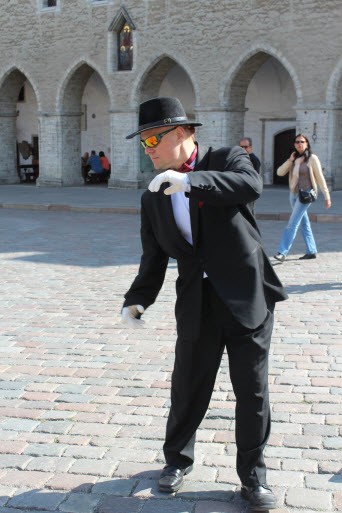
I’d rather donate three pints of blood in an hour than be on a flight with a live musician or improvisers. I’m one of you, guys, and I don’t begrudge you the money, but I will not interact with you.
I think someone in Virgin corporate learned the wrong lesson from the funny PA announcements some Southwest flight attendants make. Those presentations work because they’re fast, they’re hilarious, and they’re over.
Gamification: Deploy the Appropriate Tools
My previous set of posts described elements of gamification (such as meaningful choices and conflict) and how to incorporate them into business and improv. Kevin Werbach and his coauthor Dan Hunter also identify six steps to gamification (For the Win, p. 86), which I think provide an excellent framework for business and theatrical endeavors. I took a wild stab at designing for fun in my last post. In this post, I’ll talk about deploying the appropriate tools.
As a quick review, the authors’ six D’s are:
- Define business objectives
- Delineate target behaviors
- Describe your players
- Devise activity cycles
- Don’t forget the fun!
- Deploy the appropriate tools
Deploying the appropriate tools is where the cool concepts you’ve brought together become a system you can poke, prod, enter data into, and get feedback from. If you’re measuring data entry, you can automate the process. If you’re measuring geographic information or activity, you might program a mobile app to capture the data automatically. Otherwise, you need to create a system that combines automatic data collection with user entry. The specifics will change based on your environment and resources, but bear in mind that almost any system will require a significant investment of time, money, or both.
In an improv context, deploying the appropriate tools occurs in the context of creating your show and presenting your product. How you present your performances, from your venue to your costumes and format, shapes your audience’s expectations and reactions. Much improv comedy happens in restaurants, bars, and other spaces where the performance is secondary to the venue’s revenue stream. The venue often provides the space in exchange for a little rent or in the hope that the performers’ friends will eat and drink during the show. All the performer needs to do is put on their dark colored top, jeans, and soft-soled black shoes to get going. Troupes with dedicated spaces must pay attention to audience seating, bathroom access, and availability of snacks, drinks, and swag to buy at the performance.
You also have to create feedback mechanisms for the audience and performers. As I’ve said in other contexts, the audience isn’t there for the performers’ sake — they attended the show to have an enjoyable night out. Even your best friends wouldn’t see more than one show if the experience was so dire they didn’t enjoy themselves. You can get feedback from troupe members sitting in the audience and, in addition to watching the show, paying careful attention to the audience’s reaction. It’s easy to develop “laughing ears” where every reaction, regardless of how small, seems like a standing ovation. A teammate in the seats can help you see and hear what the audience really thinks. It’s your job to listen.
I’ll close out this section on gamification with a look at ethical considerations. Is it possible to use game mechanics to oppress your workers? Oh, yes…
 Improspectives
You must be logged in to post a comment.